March 8, 2007

Nothing like homemade strawberry jam

I'm a fruit freak. There aren't many fruits I don't like. There's nothing quite like eating a fresh fruit in its purest form, sinking your teeth into the flesh (into the skin too in many cases) and feeling it's juices trickle down your chin and arms as the flavors burst in your mouth, sending your tastebuds into overdrive. But I love fruits in all it's other forms too - fruit juices, fruit shakes, fruits in pies, cobblers, candies, cakes, preserves, chocolate; fruits in my cereal, with my yogurt, on my salads, even dried fruits, I think you get the picture. :)

Second only to (Philippine) mangoes, strawberries are at the top of my list of favorite fruits. It's funny how the sight of strawberries never fails to cheer me up regardless of what kind of day I'm having. What's not to love? They're pretty to look at, these heart-shaped little red gems, they're incredibly sweet and delicious and pack a flavorful punch with each bite, they're fat free (!) and are high in fiber and Vitamin C (even more than a citrus fruit), rich in anti-oxidants, and they're easy to eat and prepare-no peeling or seeding required, and they're so versatile.

As an aside, did you know there's an entire museum dedicated to this fruit in Belgium?

Now when I'm confronted with a bowl- or basketful of strawberries, my brain begins to reel with a swirl of possibilities. As was the case when I bought home 5 kgs of the fruit from Baguio. Actually now 2 1/2 kgs, because I sent half to my sister.

Do I mash it milk and sugar like I'd always done as a child? Should I dunk it in Nutella, mmm? Or pour melted chocolate all over it then dip in cream? Or maybe fire up the blender and make some strawberry-yogurt smoothies? I could save some to use on my cereal and muesli too. Am I feeling brave enough to attempt the strawberry trifle I've often dreamed of making? Whatever I decided to do with them, I needed to do it fast! I had to make the most of every piece because they weren't going to last much longer.


And what better way to preserve the flavor of these sweet strawberries than to make jam? So make jam I did. I heaved off the shelf the tome that is The Gourmet Cookbook and found two recipes. One for a quick and easy version, and the other which required longer stove top time which is what I eventually went with.

I halved the recipe and followed the instructions, marvelling the entire time at how simple and easy it was. As I stirred and skimmed, the sweet intoxicating fragrance of the strawberries only intensified as the sugar melted into thickening red oblivion. The result was a brilliant red jam with the perfect amount of lumps and a flavor so amazing, I swore I'd never settle for store-bought strawberry jam again. My folks loved it, and so did a couple of friends I each gave a small jar to.
Again I wonder, why have I never made my own jam before?

Strawberry Jam
adopted from The Gourmet Cookbook
Makes 2 medium-sized jars.

1 kg fresh strawberries, rinsed and hulled
1 ¾ cups sugar
3 tbsp lemon juice

Sterilize jars and lids by boiling them in hot water for about 10 minutes.

Chill a plate for testing later. Using a potato masher, crush strawberries lightly. Transfer to a heavy bottomed pot and add the sugar. Bring to a boil over moderate heat, stir and skim off foam frequently for 10 minutes.

Add the lemon juice and cook at a slow boil, skimming and stirring frequently until jam tests done.

Begin testing at 20 minutes; remove pot from heat while testing. Drop a spoonful of jam onto a chilled plate and refrigerate for 1 minute, then tilt plate. Jam should remain in a soft mound and run slightly.

Drain jars upside down on a clean kitchen towel for 1 minute, then invert and ladle jam into jars. Leave about ¼ inch space at the top. Let jam stand for at least 1 day to allow the flavors to develop. (If jam won't be consumed immediately, seal and process the jars properly.) Keep refrigerated.

That's it! :)
Here are some helpful tips I gathered from the same book:

When picking strawberries, choose fresh and fragrant ones with an even color; without a white or green 'shoulder', an indication that they aren't ripe. Discard any moldy berries, but those that are merely soft, wrinkled or bruised can be used.

Store berries in a single layer on a baking sheet, or in a shallow baking dish lined with paper towels in your refrigerator.

Don't wash them until you're ready to use them, and leave their green caps on until you've dried them so the don't get waterlogged. Because of their high water content, strawberries can't be frozen as successfully as cherries or blueberries.

Homemade guava jam, here I come! :)

March 7, 2007

The Salad Bowl of the Philippines

The 'main' greenhouse

The mere mention of Baguio triggers my sensory memory. Somehow during my past trips to Baguio since my childhood, my brain had subconsciously programmed into my memory every thing about this city that toyed with all my senses. The beautiful pine trees and their distinctive fragrance, the gorgeous mountain-top views, the taste of sweet fresh strawberries mashed with cream/milk and sugar (my favorite way to eat strawberries as a child), the sound of horses hooves and my the happy squeals of children astride them, and of course the feel of the crisp cool mountain air that lowlanders like us are deprived of.

what's left of the sweet strawberries after picking

It was nice to come back to all that after so much time away and be able to top-up those memories for later enjoyment. If you can look past the newly-opened SM mall, you'll see that not much has really changed. All the elements that make it the summer capital of the Philippines are still there.

And whenever I come to Baguio, I am a woman on a mission. That is, to bring home the best lettuce, broccoli and strawberries, among other things. Benguet, the province that surrounds Baguio and La Trinidad, is after all the Salad Bowl of the Philippines. It is also called Strawberry Country as this is the only place in the entire country where strawberries thrive.

look at all that lettuce! Can you guess what I'll be taking to the office for lunch everyday this week?

I was quite happy to make my purchases at the well-stocked city market but I was beyond delighted when we were invited to pick our produce from an organic farm in La Trinidad! My friend's lovely aunt arranged it all for us.

So midday on Saturday, we were accompanied by Sister Josephine from St. Louis University to the Benguet State University organic farm, just about 2-3 kms. away in La Trinidad. She regularly takes her students on field trips there so she was our 'ticket' to this private farm. She explained that what makes this farm unique is that spring water is used for irrigation, and not recycled canal water as other farms purportedly use. Now, I don't know about you, but anything a nun tells me I am inclined to believe.

curly leaf parsley

Fifteen minutes later, we turned into an unmarked dirt road and we passed several greenhouses to our left. She explained that inside those greenhouses was where experimental farming was being conducted. We arrived at what looked like the main greenhouse as it appeared to be the biggest of them all. Johnny, the resident farmhand, was expecting us. With knife in hand, ready to hack away, he led us into the greenhouse where row upon row of the most vivid shades of green greeted us.

Top row: broccoli and red beets
Bottom: cherry tomatoes and bell peppers

I ogled the broccoli plants, I had never seen a broccoli plant before. At first I didn't know what they were, these huge blue-green leaves. It was only when I bent and peered into the center did I see the familiar little head hidden among the leaves. Such a big plant that takes up so much precious fertile space, for such a small harvest. I asked if the leaves were edible. Nope, Johnny shook his head, they're used for compost. Interesting. No wonder they command quite a hefty price.

There were cherry tomatoes on the vine, gorgeous beds of parsley, red and green bell peppers hanging from their stems like shiny ornaments on a short and wide christmas tree, various lettuce varieties such as leaf and romaine, and of course the strawberries. Those elusive (to us lowlanders) little red gems that cost an eye once transported to Manila. We each bought 5 kgs of strawberries (P60/kg), 2 kgs of broccoli and about 8 kgs total of the other vegetables (all for P50/$1 per kg each) to be divided among ourselves. Now that's what I call a sweet deal.

5 kgs of strawberries for only P 300 ($6)!

Before we headed back though, we made a quick detour to the La Trinidad strawberry fields (pictures below) to have a look-see. This is obviously a popular tourist attraction because we were barely out of the car when we were hounded by peddlers. It was a beautiful day for picking strawberries, and if we didn't have to go back to meet the guys for lunch I would have loved to go out there and get my hands dirty.

for sale: strawberry wine & strawberry jam
the ubiquitous walis (grass broom)

March 5, 2007

Baguio revisited


I can't remember exactly when I went to Baguio last because it's been so long. But I think it was in '99 when I went for the Panagbenga flower festival, as part of an official tour of Philippine fiestas for work. As much as I love being up in the mountains amidst the cool pine-scented air, I used to dread the long 6-7 hour drive. But my trip to Donsol last year, which had me in a car for 14 hours each way, fixed that.

So our journey last Friday was pretty much a breeze. Being in the big and comfortable company bus with the airplane seats, cozy couch in the back, dvd player and cooler filled with drinks even made it was actually quite enjoyable. Made even more so by the fact that I was with some of my bestest friends.

the backyard bathed in the early morning sun, Camp John Hay
Because Baguio city is located about 1,500 meters above sea level the climate is naturally at least 10 degrees cooler than in Manila. It was lovely "sweater-weather" for us the entire weekend. Those of you who also live in a tropical and humid country know the joy this can induce from time to time. Every morning was a struggle though, I would have to begrudgingly force myself to emerge from under my warm duvet, pondering the possiblity that gravity was indeed stronger under my bed that precise moment. But thoughts of hot chocolate, ensaymada, Baguio longganisa (pictured at left) & fried rice waiting just beyond my bedroom door was all it took to coax me out of bed finally.

While the men played mini-golf, we explored Baguio's public market, a popular one-stop shop for the freshest produce from the Cordillera mountain region, native Ifugao wood-carved souvenirs, fruit preserves and yams, walis tambo (top-quality brooms), flannel blankets, peanut brittle, raw honey, native woven handbags, plants, flowers, handwoven fabrics, and chocolate-covered corn flakes among other things. Aside from how complete the market is, what surprised me the most was how utterly clean it was. No wonder it has become a popular tourist destination in the city.

I had my first taste of binatog at the market.
Binatog is steamed white corn kernels mixed with milk, grated coconut and sugar.
It was a chewier version of mais con hielo without the ice. Yum!

No trip to Baguio is complete without the requisite visit to the legendary Good Shepherd convent , home of the most sought-after fruit preserves such as strawberry jam, ube jam and peanut brittle. If there is one thing (aside from the abundance of fresh strawberries and horses) that I love most about Baguio, it's the Good Shepherd ube jam! I have not found anything remotely as good as this sweet, smooth and creamy version.

They sell them freshly made and still warm, with a reminder to leave it uncapped until noon the next day. I barely made it back into the car, when with my finger I scooped up some of the purple goodness from the jar. Mmmm, still as delicious as ever! I wish I had bought more, but I find comfort in the fact that you can now avail of Good Shepherd products in Manila. In fact, I see a trip to Market! Market! in my future.

Some pictures taken at Mines View Park

What's in a name?

Big & small kulangot (literally translates as, -get this- booger), I know it sounds gross but it's good! Found inside the coconut shells are wads of sweetened coconut , like cocojam, which you scoop out with your finger or a tiny spoon.
The small ones also made good ammo for the new tiradors (slingshots) we bought for the kids at Mines View Park.


Did you really think I could have a post about Baguio without at least one horse picture? ;)

February 27, 2007

Animal attraction

'Avilon' comes from the words aves meaning birds and lon meaning land.
And there were lots of birds!

I can't remember the last time I went to Manila Zoo, but I remember clearly being horrified at the sad state of affairs over there. Many of the once-proud animals looked half-dead, and those that still had enough energy in them paced in their grim enclosures with an almost crazed look in their eyes, fearful I'm sure of suffering the same fate as their fellow zoo mates. It broke my heart. (The zoo has since gone through a major overhaul thanks to the Friends of Manila Zoo.)


I could no longer bring myself to own anything that was to be confined like birds, hamsters and rabbits. I even drained and sold the 20 gallon fish tank I owned. As much as I loved having all these pets in my home, I couldn't bring myself to sleep well at night knowing I was keeping them from roaming freely in their natural habitat.

Joey, no relation to our friend over at 80 breakfasts ;)

But don't get me wrong, I have nothing against zoos as most are established and maintained to promote education and research and play an important role in the conservation of endangered wildlife and where I like to believe they treat their inhabitants humanely. Today, we have a number of such zoos around the city like Malabon Zoo, where I stroked the fur of my first tiger, had a snake draped around my neck, and carried and cuddled the cutest baby powder-smelling and diaper-wearing baby orangutan.

In 2003, another such place opened it's doors to the public in Montalban (now Rodriguez), Rizal, the Avilon Zoo. The zoo is the brainchild of Jake Gaw who was forced to find a new home for his growing pet collection after neighbors started to complain. I heard only good things about it so I was excited to check it out for myself with my friends and their kids last Saturday.

After making a couple of wrong turns (and laughing insanely at the comical directions we printed off the net), we arrived at the zoo at 12:30, two hours after we left ParaƱaque. We had a quick lunch of homemade tuna sandwiches, hotdogs and corn (you can bring your own food) in the pavillion, surrounded by a lily-covered moat, we began our exploration. We were a little lost at first as there are no directional signs or marked trails within this 8 hectare nature reserve.

Barely halfway through the grounds, I regretted not hiring a tour guide. Most of the animals cages/dens were not labeled. It was only because I asked a lady from the group with a tour guide that I knew the rhinoceros-like mammal with the funny snout was a Malayan tapir. I was very impressed with the wide range of exotic animals and those endemic to the Philippines. I didn't expect to see kangaroos, hyenas and flamingoes. Until now I didn't know about the Brazilian arapaima, the world's largest freshwater fish, which you can feed chicken heads for a small fee.

One of my favorite residents - the sun bear. Isn't he just so cute?

The zoo's commitment to maintenance and sanitation is apparent in it's surroundings and inside the animal's homes which are simulations of their natural habitat. There are sections dedicated to nocturnal animals such as armadillos and primates where you are prohibited from taking pictures even without the flash. Though the zoo was busy with groups of school children and families, it was big enough that it hardly seemed crowded at all. P50 / $1 would buy you an opportunity to have your picture taken with an owl on your shoulder, a snake on your lap or draped around your neck, or astride a miniature horse.

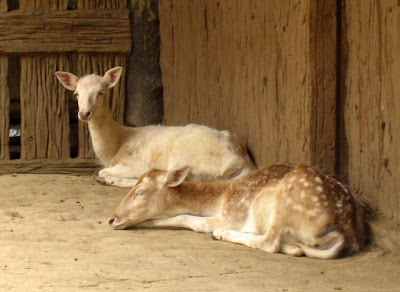
sweet Visayan spotted deer

I would strongly recommend hiring a tour guide, not only to help you understand the origins and habits of each animal, but to make sure you don't miss anything. I found out later from a friend that we had missed seeing the capybara, the world's largest rodent and the different species of crocodiles. The zoo is home to over 3,000 animals, 500 species which make it well worth the long drive.

clockwise from top left: boars, Malaysian tapir, Sumatran tiger, hyena

Avilon Zoo

Eastwood Greenview Subd. San Isidro, Rodriguez, Rizal
Tel. 634-5550 / 0917-8995126
Entrace Fee: P208 / $4 ; Tour guide (optional): P350 / $7
Hours of operation: 8am to 5pm everyday ; You can find a map to the zoo
here.

February 25, 2007

What a dad will do for his daugther

What A Dad Will Do For His Daughter
by Cheryl D'Aprix

What a Dad will do for his daughter is rock his sick baby girl
until the sun peeks through the darkness
letting him know the night of worry is over.

He will take her small hand in his and walk slowly
as she takes her first walk to the ice cream shop
to share a cone full of heaven on earth.

He will sip from the tiny tea cup she has set in front of him
and in harmony with the stuffed animals carefully placed in their seats
he will sing the praises of her great hospitality.

He will sit through dance recitals and fashion shows
where he is the only audience
and will clap with the enthusiasm of a thousand people.

He will take her fishing and play soccer,
and introduce her to the world outside
as if just experiencing it for the first time himself.
Perhaps he is.

He will sit with her through sweat and tears over homework
that was supposed to be turned in the day before
and he'll smile as they finish, seeing her relief.

He will place a firm hand on the shoulder of the young man
that comes to take her to the school dance
silently letting him know where he stands and what he expects.

He will watch with overflowing pride
as his young lady accepts her high school diploma
and will silently pray to God to calm his fears
and get him throughout the day.

He will be full of conversation and more than happy to listen
when she calls home now and then.
Even when the game of the year is on.

He will gently fold her arm around his
and with all the courage and faith he can hold onto
he will stroll down the aisle, giving her hand but keeping her youth.

He will be the first one in the maternity ward ,
at the nursery window, carefully inspecting the activities
of his new family member.

Another part of her, another part of him.
He will reassure her as time rages on
and the signs of his old age start to frighten her.

He will caress her hand with a passion to which she has never felt
as he whispers his last wishes to her.

He will come to her heart for all her life
as she sees his manner in herself or his features in her children.
He will live in the smiles that grace her face
as she remembers the things he did for her.

And he will teach her how to make paella... :)

My dad is the family paella-maker. It's pretty much the only thing I've ever seen him cook in my life, now that I think about it. He always makes it on the exact same spot in the garden where he ignites the flame and fans the coals while he waits as his 'assistants' (read: my mom and kitchen staff) do all the prep work in the kitchen and bring these out to him. They then have to assembled just so. There's something almost theatrical in his manner and it's always amusing to watch. (Except for the time a burst of flames from the coals engulfed his hand :( )

Last weekend, my sisters and I asked him to teach us how to make his paella. Which he did all too willingly and happily while we followed his instructions and documented the whole process. We each had our assigned roles: cook, scribe and photographer. Guess which role was mine? ;)

dad's paella 4

Mise-en-place


collage

The equipment

dad's paella 5

Saute, pour, simmer...

dad's paella 3

Ooohh almost there...

dad's paella
Ta dah!

dad's paella 2
Buen provecho! :)